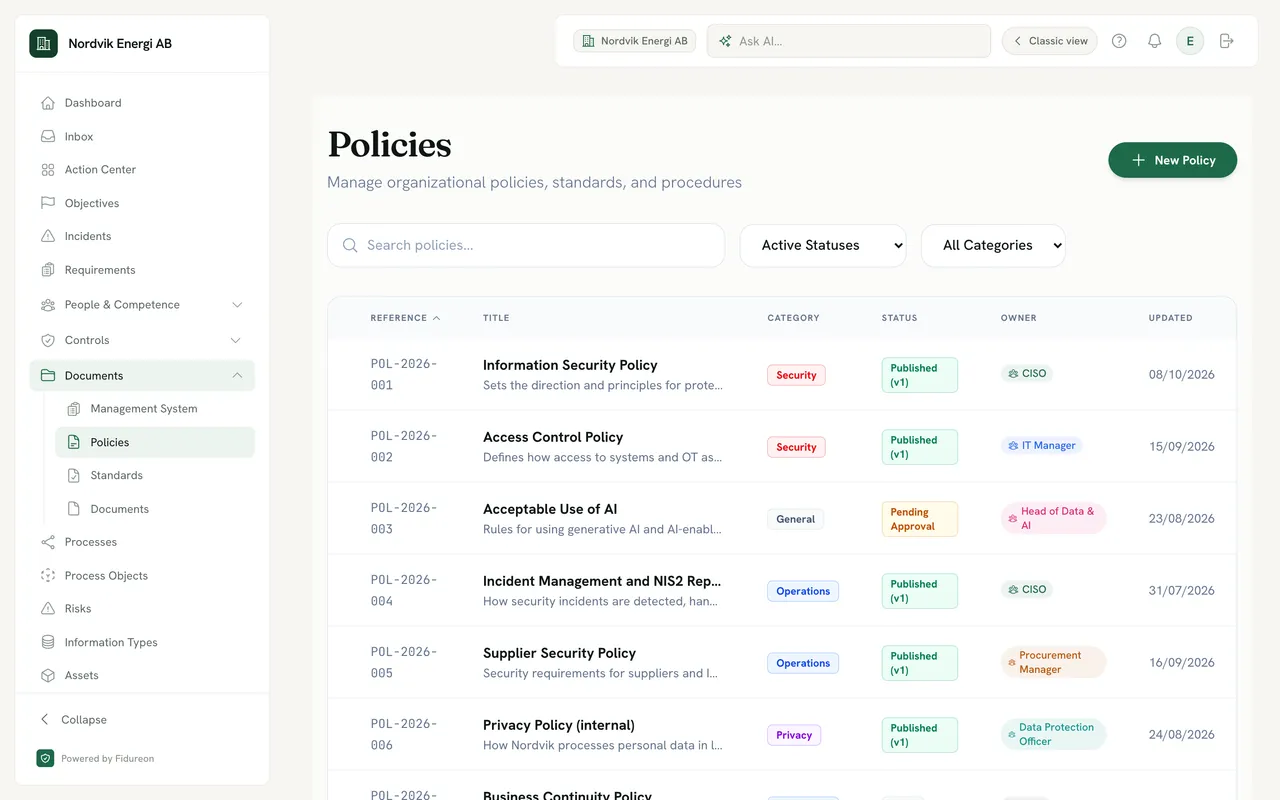
An AI policy, from draft through approval (5.2, A.2.2).
Your AI policy and the documents around it, versioned, with an approval workflow, version compare and restore, and PDF export.
ISO/IEC 42001:2023
Run the ISO 42001 clauses and decide which Annex A controls apply, on the same AI register you keep for the EU AI Act. When a customer asks how you govern AI, show the system running.
What the standard asks
ISO/IEC 42001 is the international standard for an AI management system. It is voluntary, and it is how a compliance lead, CISO or head of AI answers when a customer questionnaire, an auditor or procurement asks how you govern AI. It rests on three things.
Set the scope, an AI policy and objectives, assess AI risks and the impact of your AI systems, make sure people are competent, then measure, audit internally and improve.
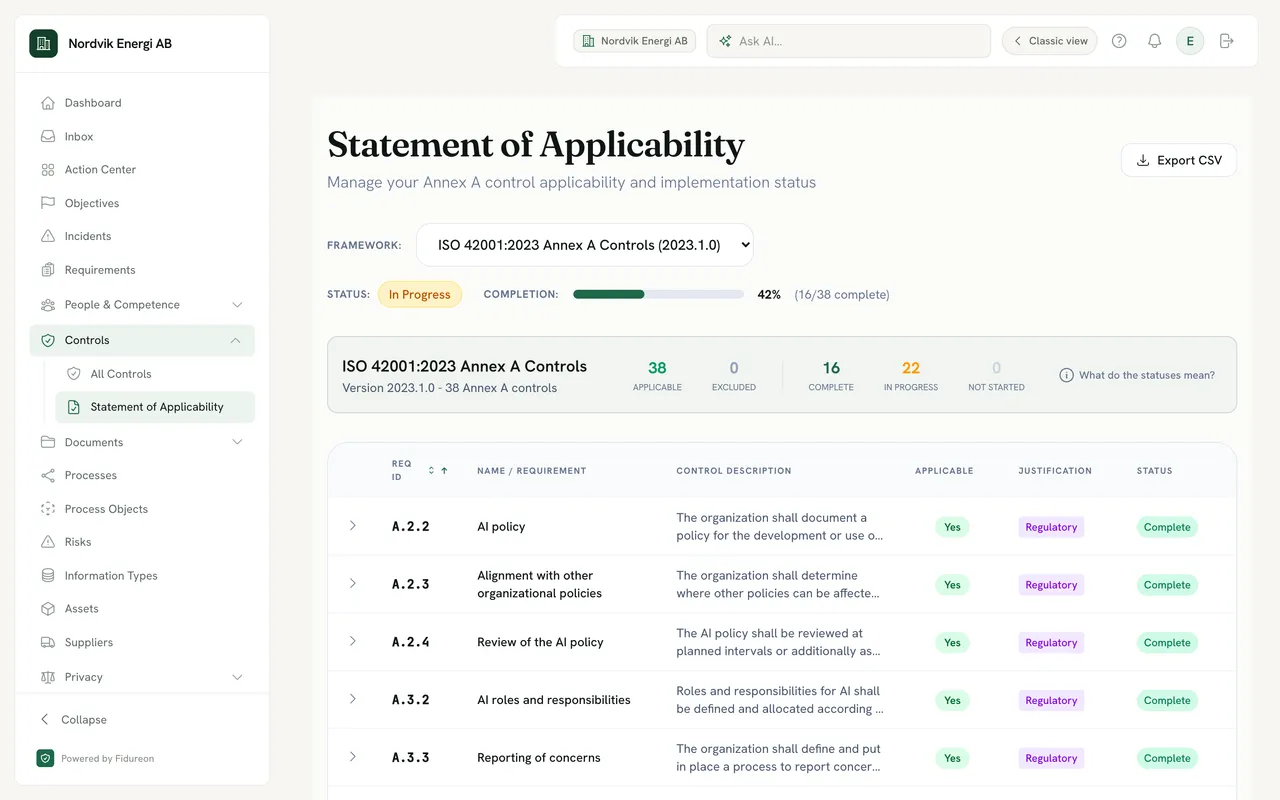
Decide which of the 38 reference controls you need, from data quality to supplier terms, and record each decision and its reason in a Statement of Applicability.
A certification body, usually an accredited one, audits you in two stages, documents first and then practice, followed by surveillance audits each year and recertification every three years.
Annex A by category
How Fidureon covers it
The parts of an AI management system that take the most time, in one place, each tied to the clause or control it answers.
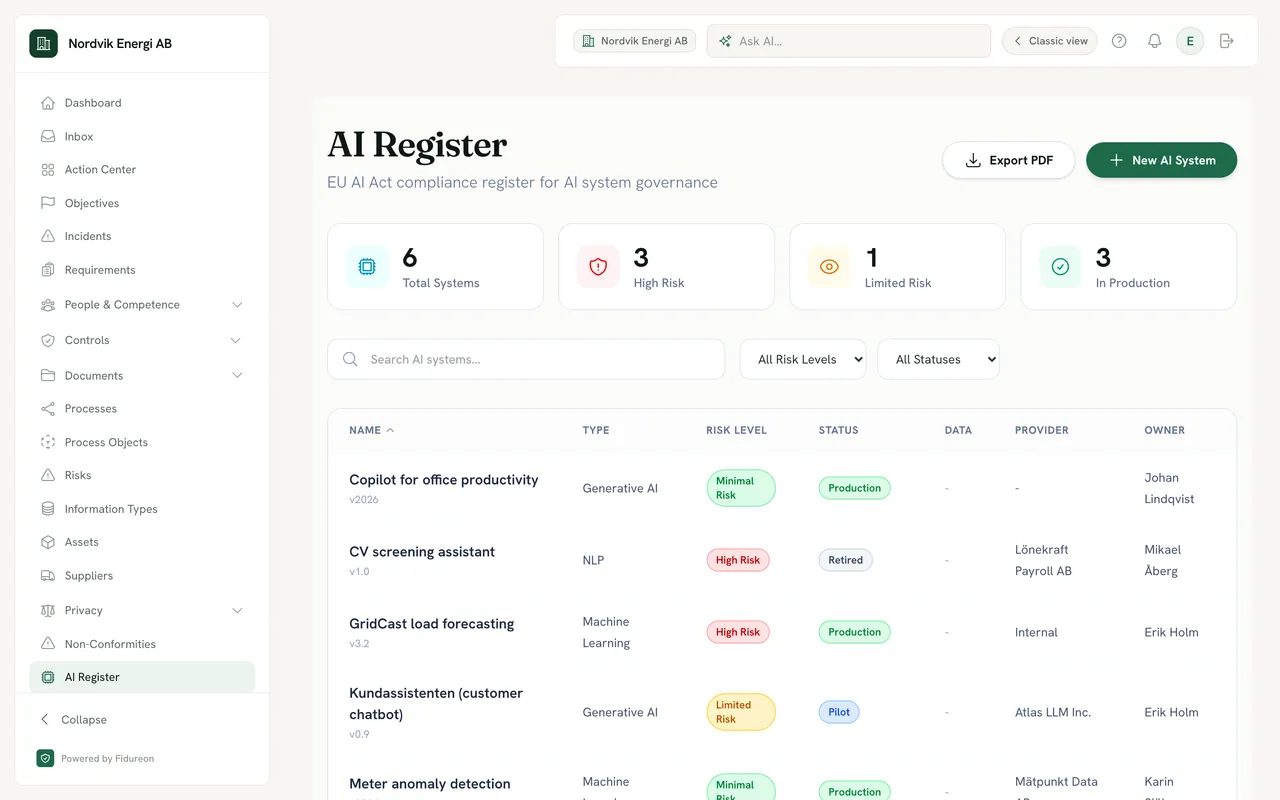
AI register
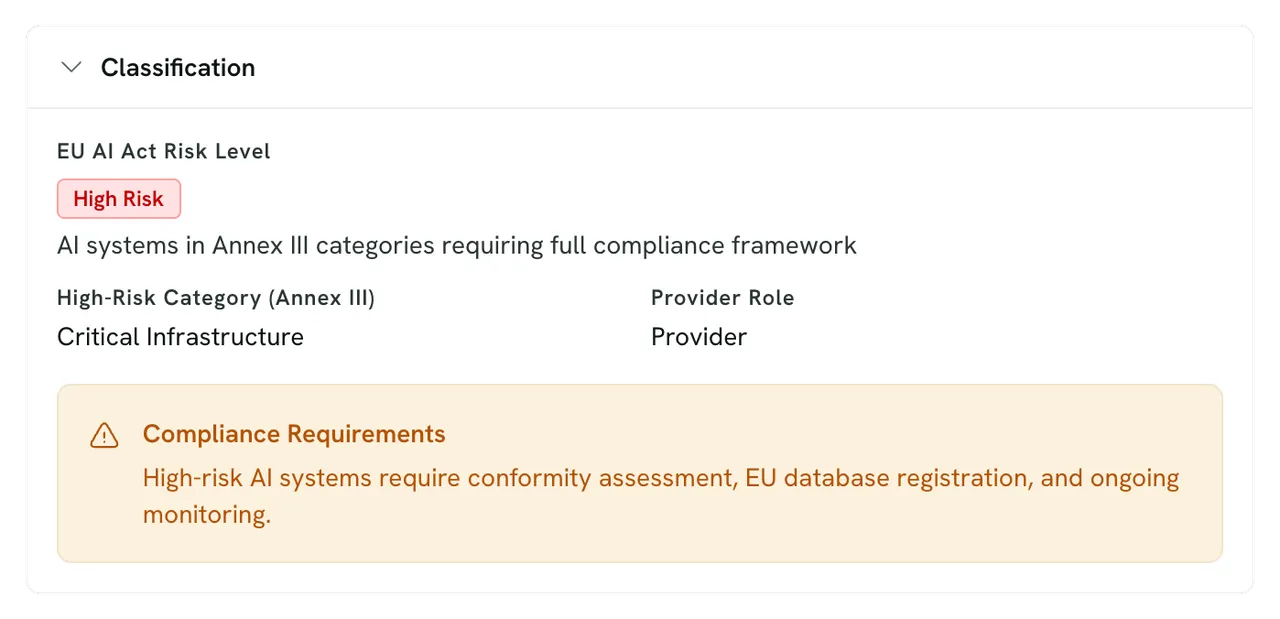
Every AI system you build or use, with its EU AI Act risk tier, your role as provider or deployer, its Annex III category, FRIA status, EU database ID and human-oversight mechanism. The same register serves the EU AI Act, and exports as a branded PDF.
Your AI policy and the documents around it, versioned, with an approval workflow, version compare and restore, and PDF export.
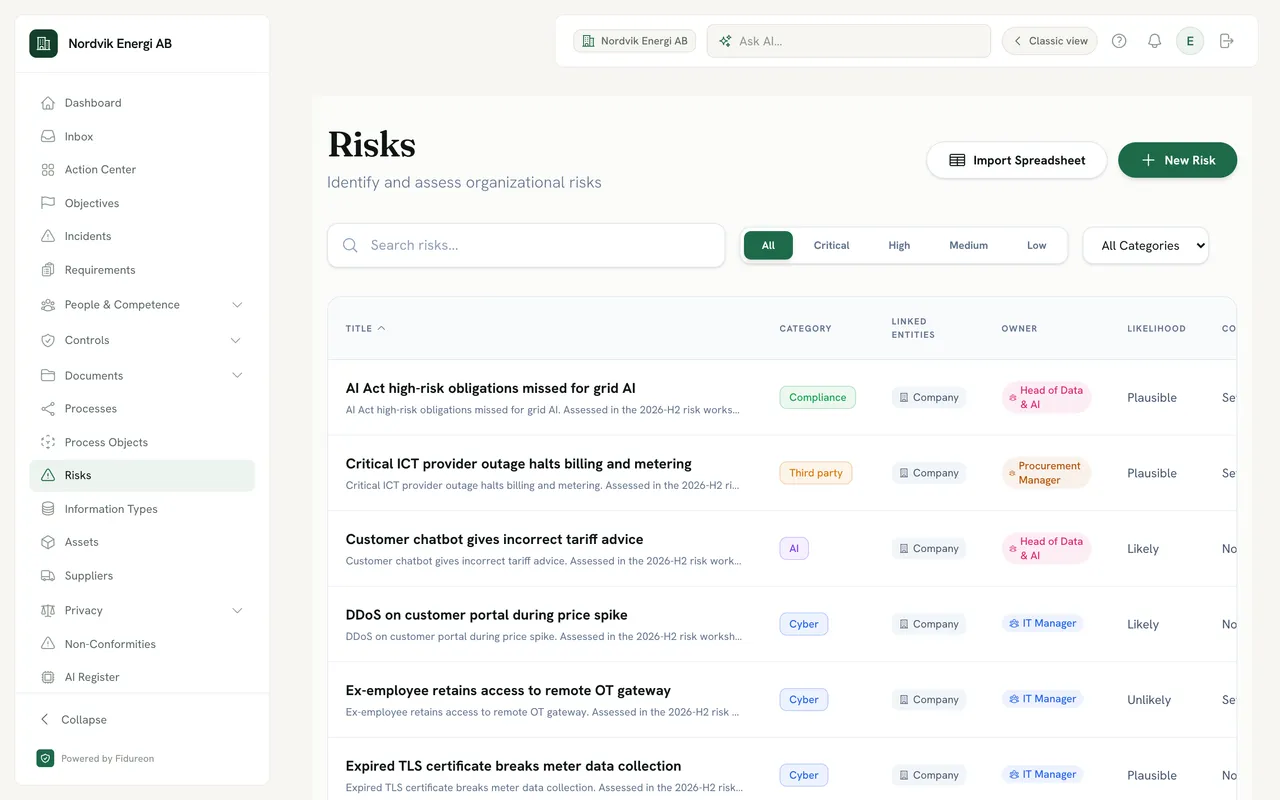
Assess each risk against your appetite, then treat it with a plan or accept it formally. Each risk links to the AI systems it concerns.
Works with the EU AI Act
Annex A.6 covers the AI system life cycle in 9 controls, and much of it is what the EU AI Act asks of high-risk AI. Link a control to the requirements it meets in both, and its status and evidence count toward both.
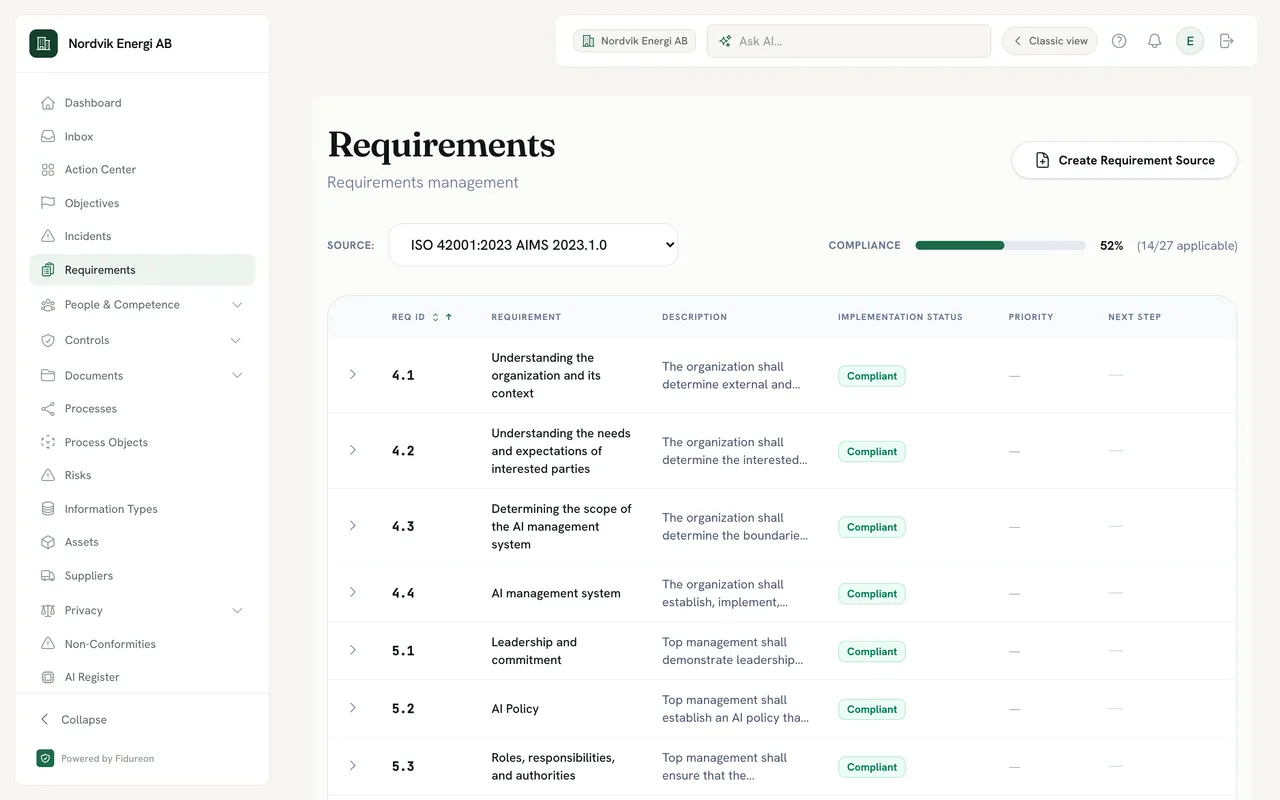
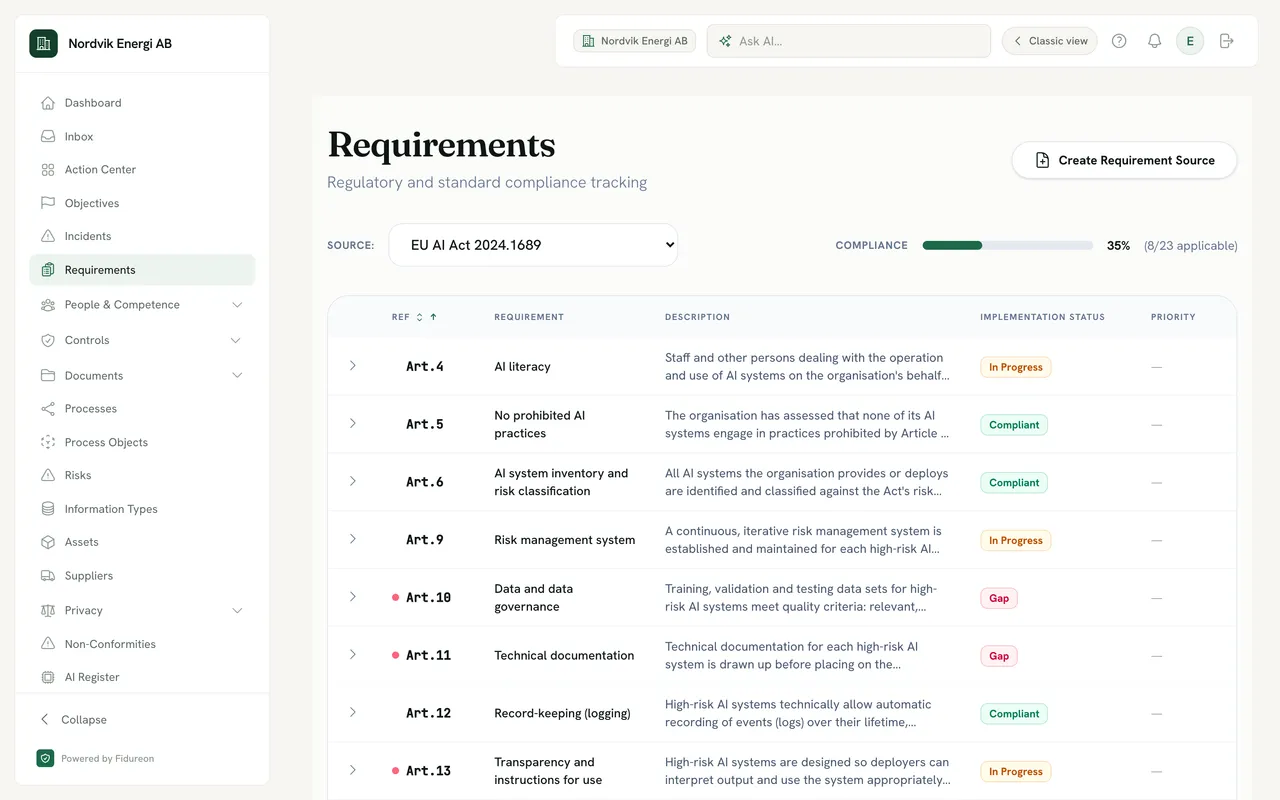
A starting point, not a crosswalk: Fidureon ships no pre-built mapping between the two, and which AI Act obligations apply depends on each system’s risk tier and your role. The AI Act’s obligations phase in from 2025 to 2028 — check the official timeline; our EU AI Act page summarises it and links to the Regulation.
See one control count toward both, on your own AI systems. Book a demo
Already on ISO 27001? Much of your ISMS can be reused. See ISO 27001 in Fidureon.
Running ISO 42001 for clients? See the partner console.
FAQ
No. An ISO/IEC 42001 certificate is issued by a certification body, usually an accredited one, after its own audit. Fidureon is where you build and run your AI management system, record your Statement of Applicability and keep the evidence, so that you are ready when the auditor arrives.
ISO/IEC 42001:2023: 27 requirements from the management-system clauses and all 38 Annex A controls in nine categories, with a Statement of Applicability you can export to CSV. The AI systems in scope live in the AI register, the same register you use for the EU AI Act.
Not a dedicated one. ISO 42001 asks you to assess the impact of your AI systems (clause 6.1.4 and Annex A.5). In Fidureon those are requirements and controls like any other: you assign actions, attach your assessment as a document or as evidence, and record each system’s details, risks and human oversight in the AI register.
The EU AI Act is law; ISO/IEC 42001 is a voluntary management-system standard, and certification to it is not the same as meeting the Act. They overlap a lot, especially in the AI system life cycle (Annex A.6). In Fidureon both frameworks use the same AI register, and you can link one control to requirements in both. The AI Act’s obligations phase in from 2025 to 2028 — check the official timeline before you plan around a date; our EU AI Act page summarises it.
Yes. ISO 42001 follows the same clause structure as ISO 27001, so much of your scope, policies, risk process, competence records and internal audit approach can be reused. A control can be linked to requirements in both frameworks, so its status and evidence count toward each. You make the links yourself, and Fidureon suggests them when you import controls from documents or spreadsheets.
Not as its own track. The free readiness check has two tracks, ISO 27001 and the EU AI Act. The EU AI Act track starts by finding the AI systems you use, which is also the first step of an ISO 42001 scope. Book a demo to see ISO 42001 on your own AI systems.
See Fidureon on your own AI systems, or start the free readiness check on its EU AI Act track, which begins by finding the AI you use.