Ask processors the right questions
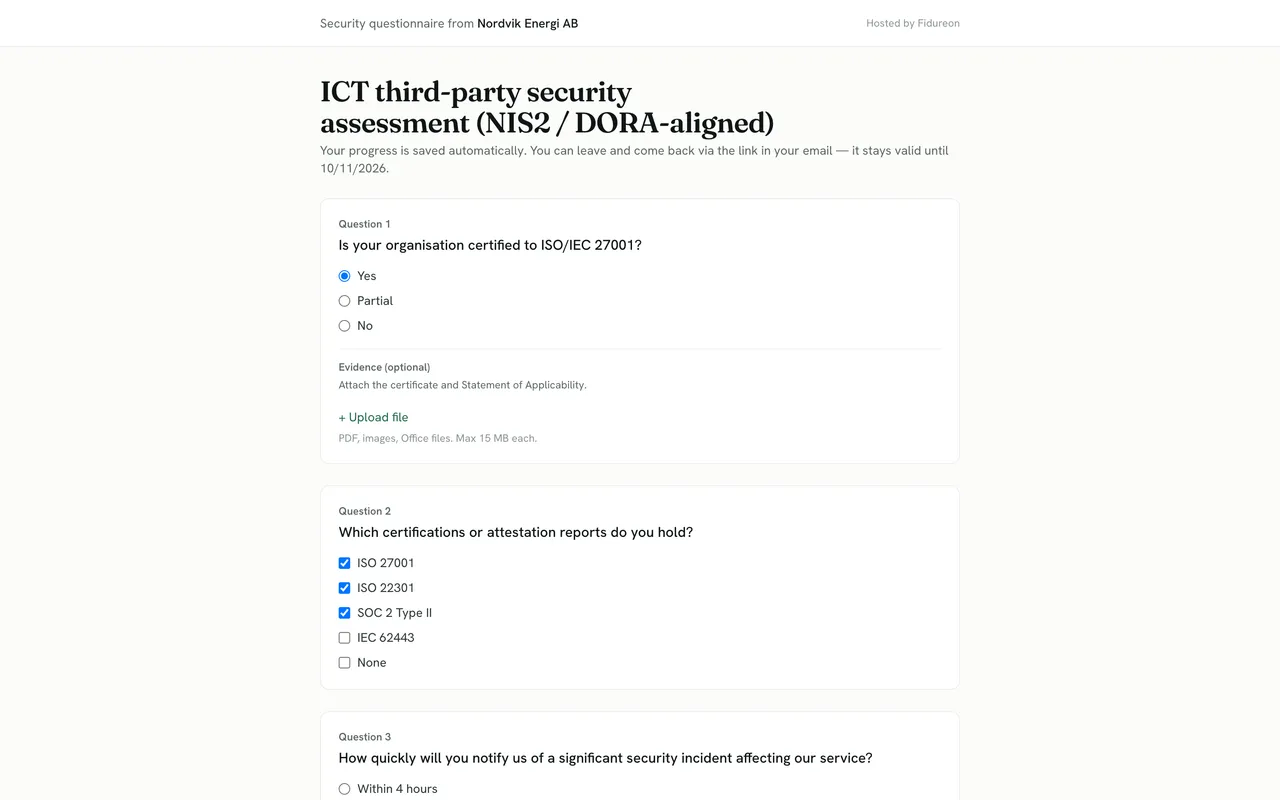
Send a security questionnaire with AI-generated questions. Suppliers answer in a hosted page, no account needed.
GDPR · Regulation (EU) 2016/679
Track the GDPR requirements, draw your processes and let your Article 30 register build from them, and run DPIAs, LIAs and TIAs with autofill and AI drafts.
The regulation in brief
Six duties most organisations work on first, and where each one lives in Fidureon. A plain-language orientation, not legal advice.
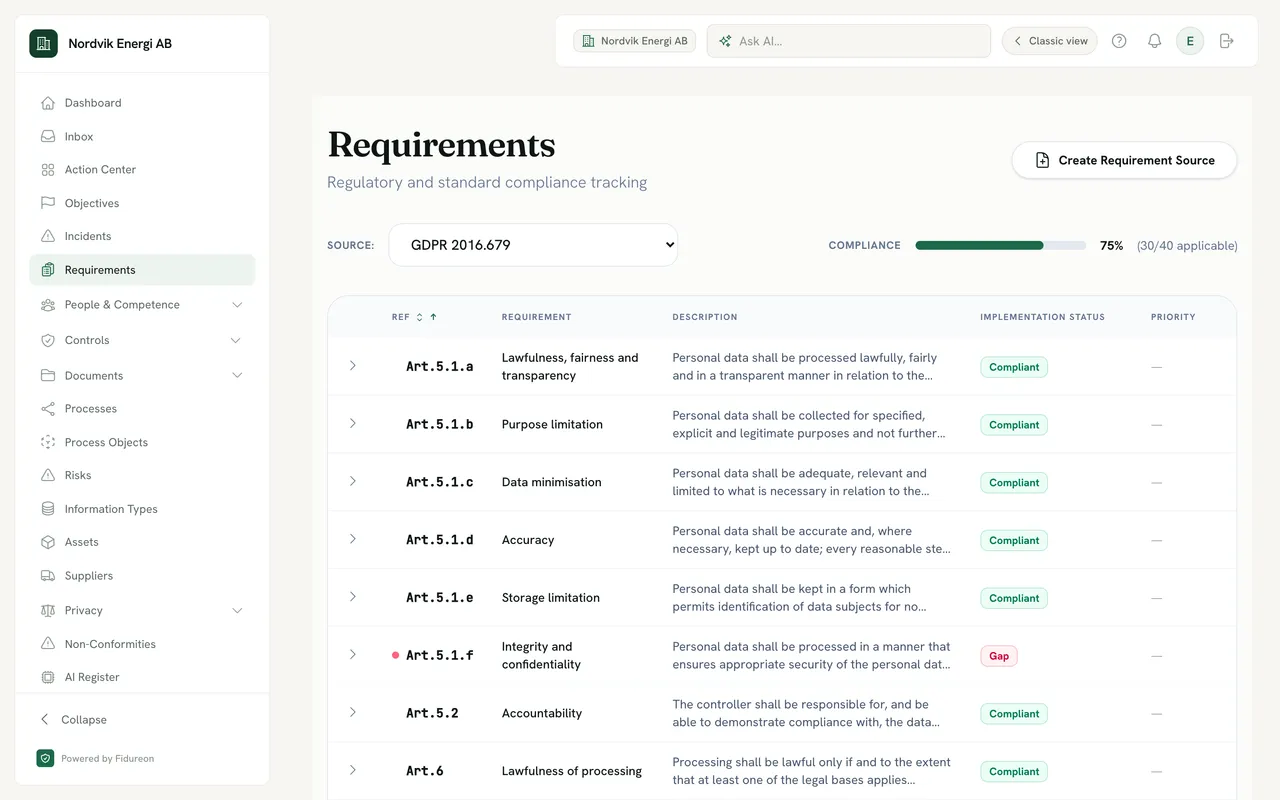
Accountability: you must be able to demonstrate that the principles are met, not just meet them.
In FidureonEach requirement links to the controls, owners and evidence behind it, and records keep a change history.
Every processing activity needs a legal basis, such as contract, legal obligation, consent or legitimate interests.
In FidureonSet the legal basis per process. For legitimate interests, run an LIA with the purpose, necessity and balancing tests.
Processors acting for you need a data processing agreement with the terms the regulation sets out.
In FidureonRecord DPA status on every supplier. It shows next to the supplier wherever its data appears in your register.
Most organisations must keep a record of what they process, why, about whom, who receives it and for how long.
In FidureonYour record of processing activities (ROPA) is built from your processes and information types, with CSV export.
Where processing is likely to result in a high risk to people, assess it before you start.
In FidureonRun a DPIA on the process: processing, necessity and proportionality, and mitigation measures with linked risks, then conclude.
Transfers to third countries need a transfer mechanism, and for many transfers an assessment of the destination’s laws.
In FidureonRun a TIA per country: the transfer, the mechanism, the legal assessment, supplementary measures and a decision.
Article 30 · from the process canvas
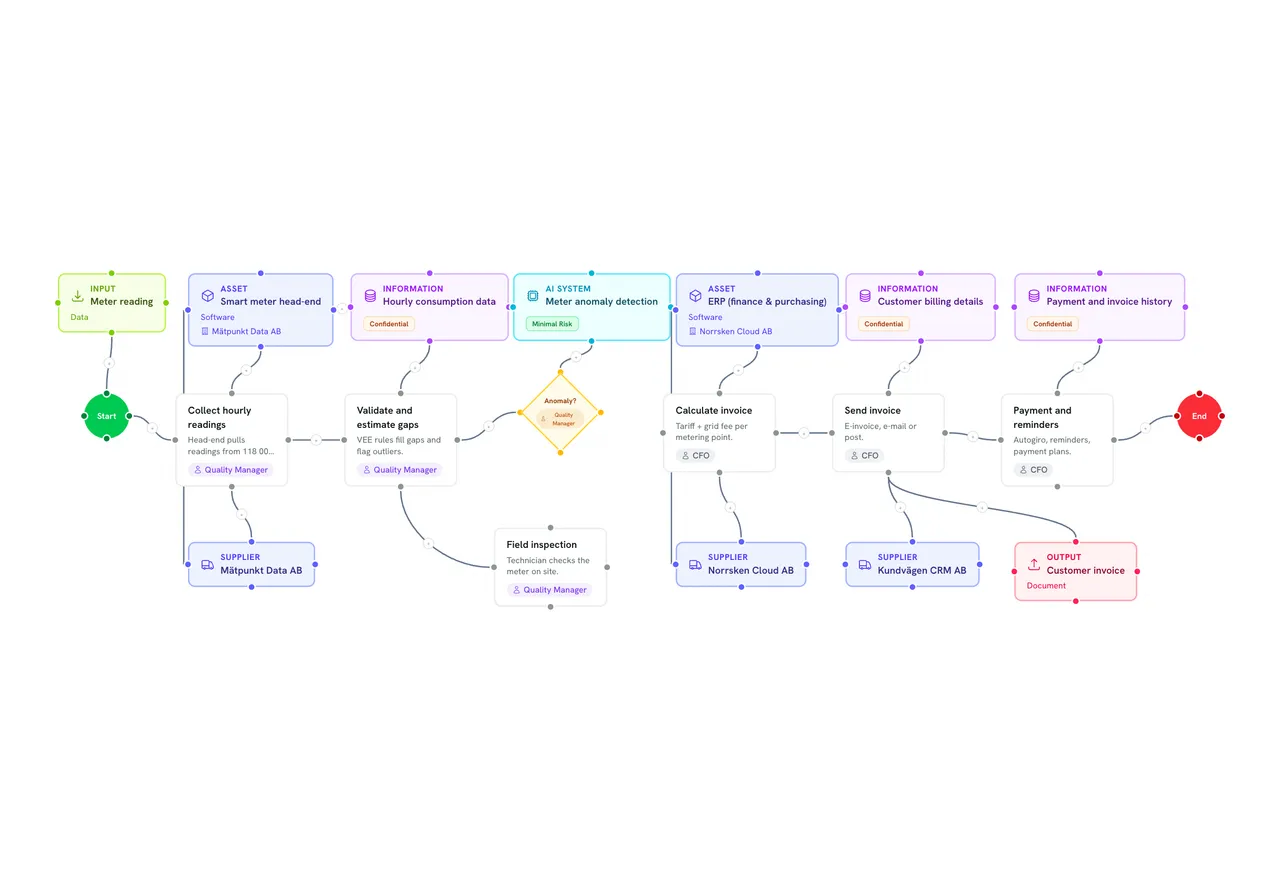
Create assets, information types and suppliers right on the canvas. The links fill themselves in, and your record of processing activities builds from them. No separate spreadsheet to keep in step.
Draw
Drag steps and decisions onto the canvas, then the assets, information types, suppliers and AI systems each step uses. Every one of those nodes points to a real record in your registers. If an asset, information type or supplier does not exist yet, Quick Create makes it and links it in one step; AI systems link to entries already in your AI register. Drawing a box on its own never adds a row to a register.
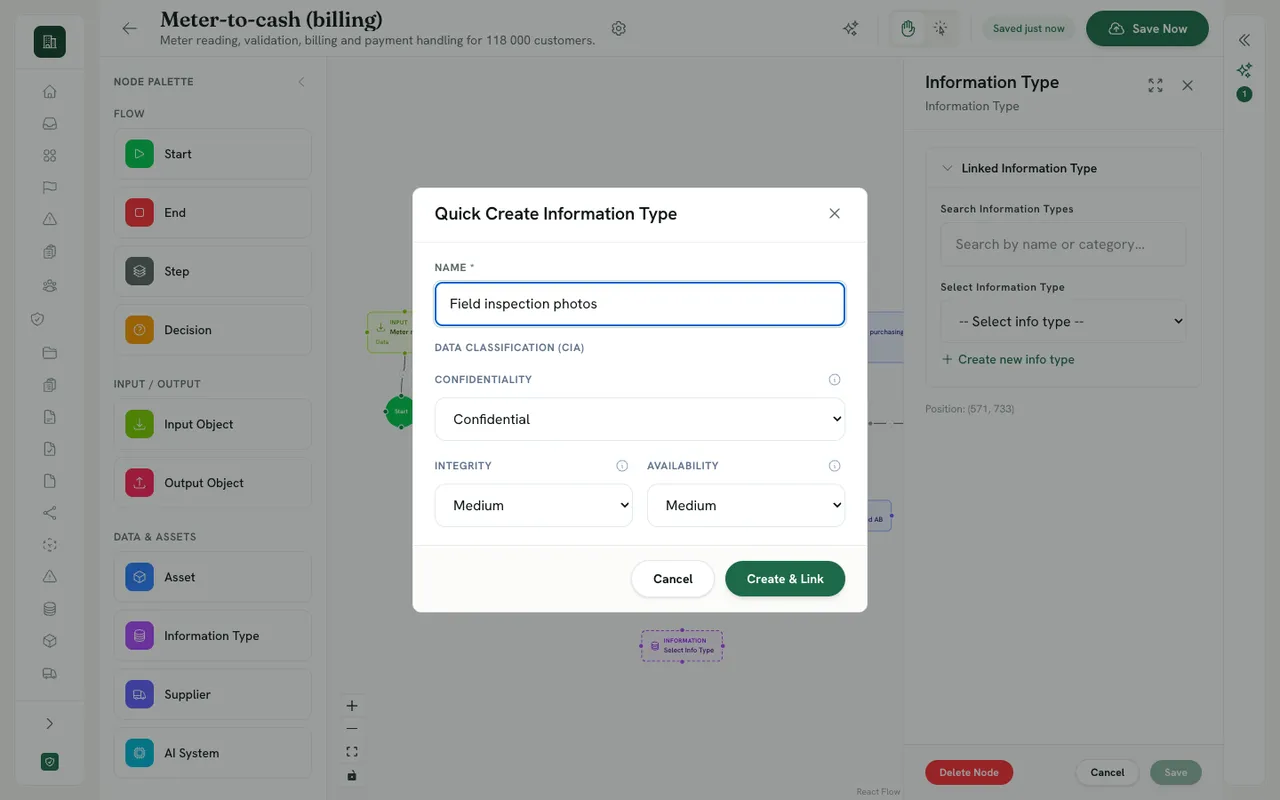
Create & Link
Name the record, set what the dialog asks for (for an information type, its confidentiality, integrity and availability) and choose Create & Link. The record now exists in its register and the node points to it.
Quick Create covers assets, information types and suppliers. An AI system on the canvas links to one already in your AI register.
Prefer a first draft? The AI Process Builder, marked Experimental in the product, can sketch the diagram for you and links only records that already exist.
Save
When you save, the process is linked to every record on its diagram. The edges link assets to the information types they hold and suppliers to the assets they run. Switch on personal-data processing for the process and it carries a GDPR badge.
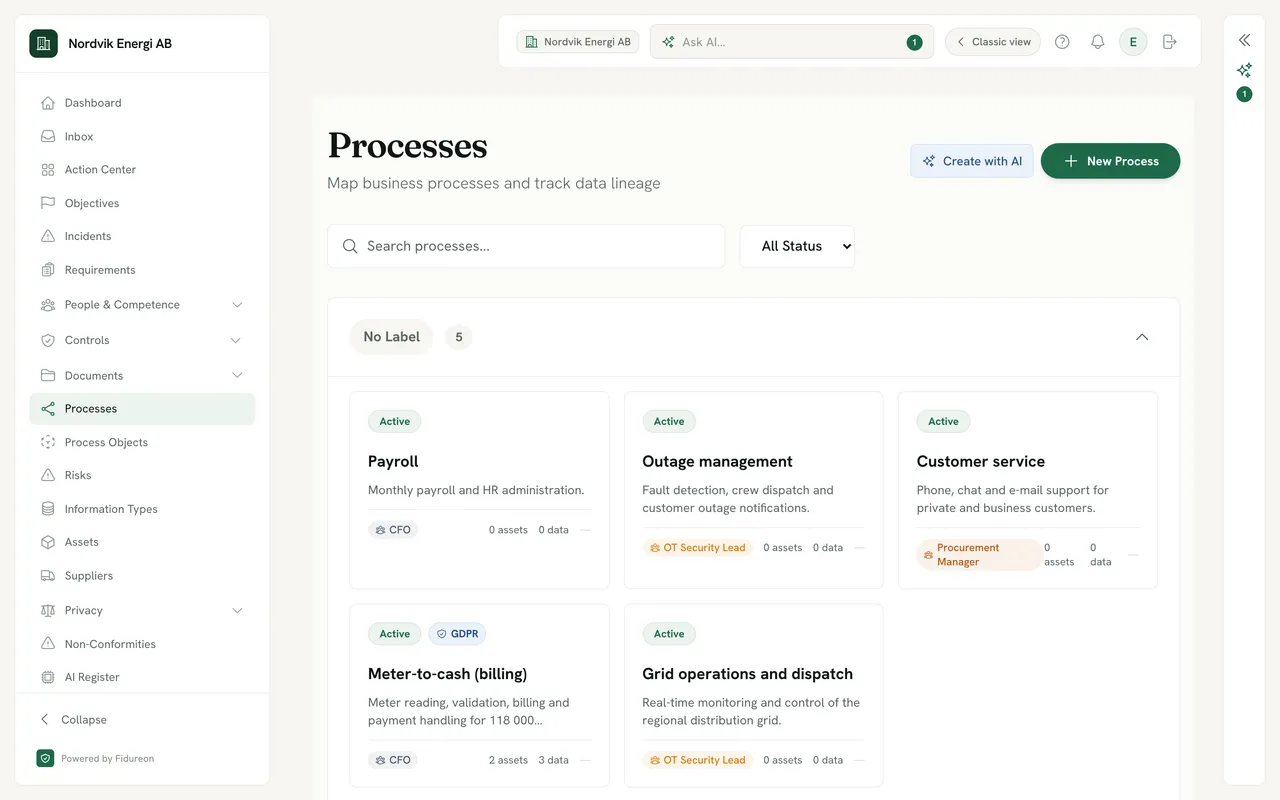
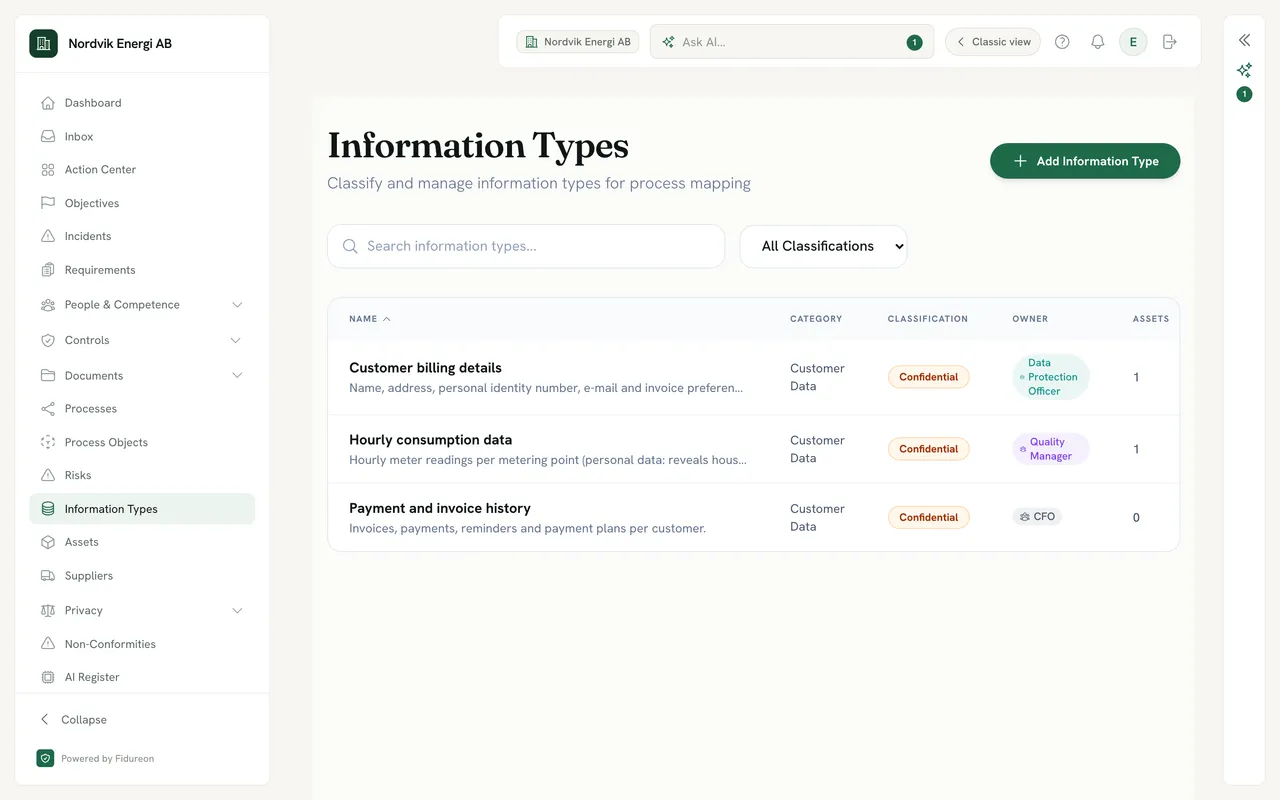
Register
Every process marked as personal-data processing appears in the register with its purpose, the information types that hold personal data, how long each is kept and the suppliers that process it, with their DPA status. Change the process and the register follows. Export it as CSV whenever someone asks.
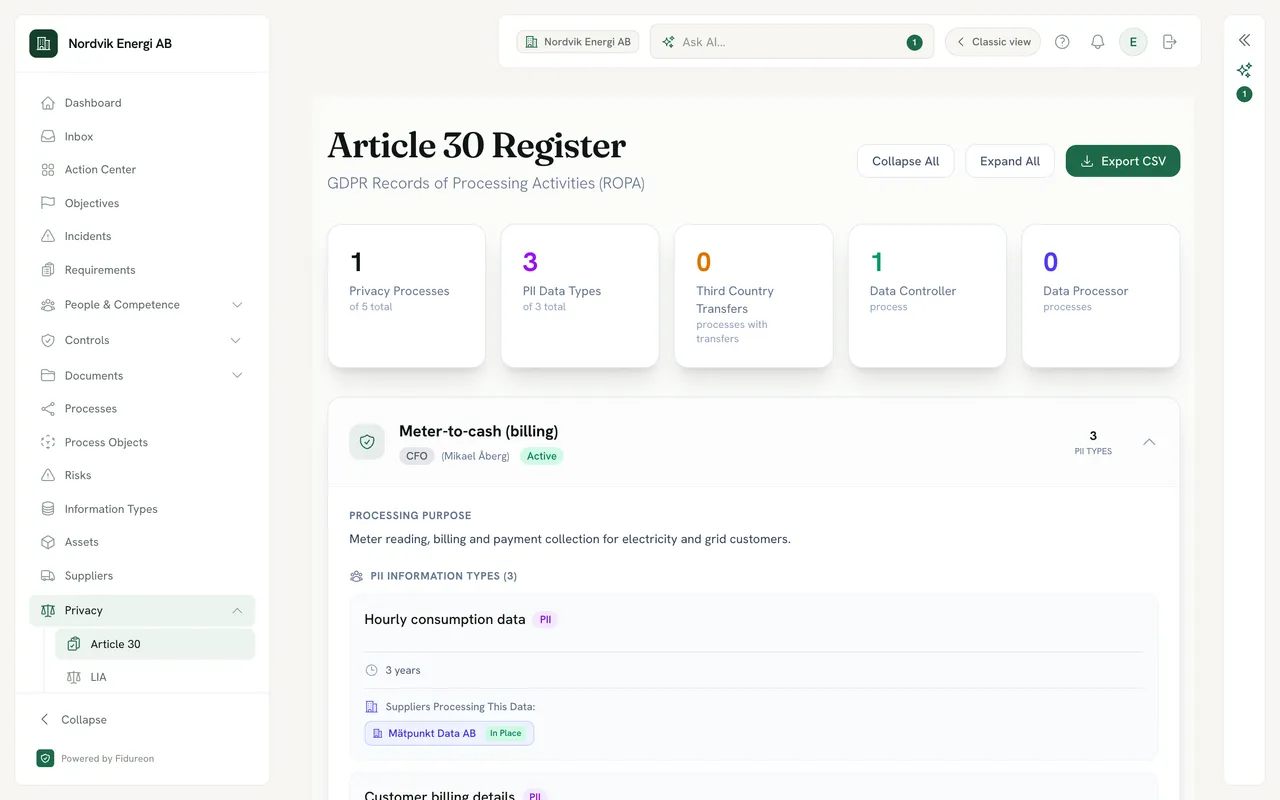
Around the register
The work that keeps the register honest happens in the same place. These are the real screens.
Art. 28Processors
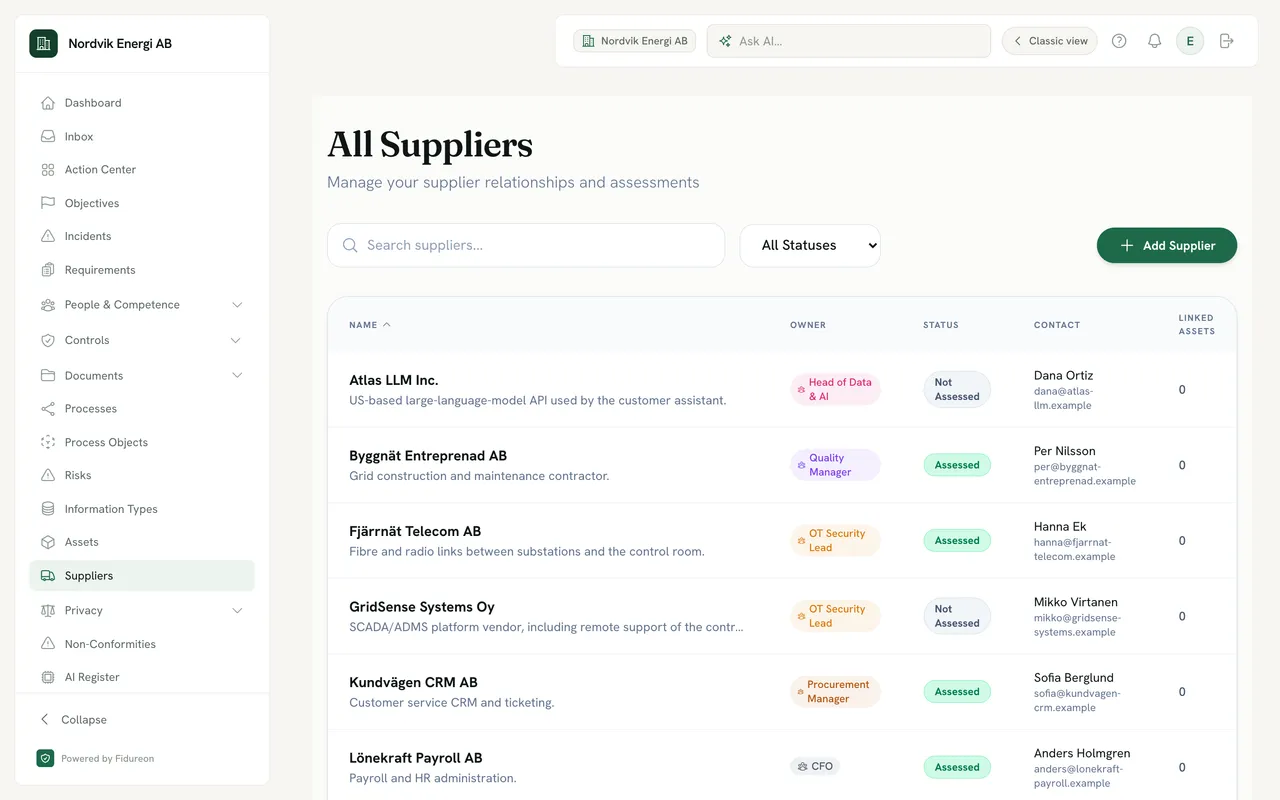
Keep each supplier with the service it provides, an owner and an assessment status, as in the list here. On each supplier record you also note whether a data processing agreement is in place, not in place or not required, and your Article 30 register then shows that DPA status beside every processor that handles the data.
Art. 33–34Breaches
Log a breach the way you log any incident: what happened, when it was detected, who owns it, and its status from draft to closed. Notifications to the supervisory authority and to the people affected go through your own channels.
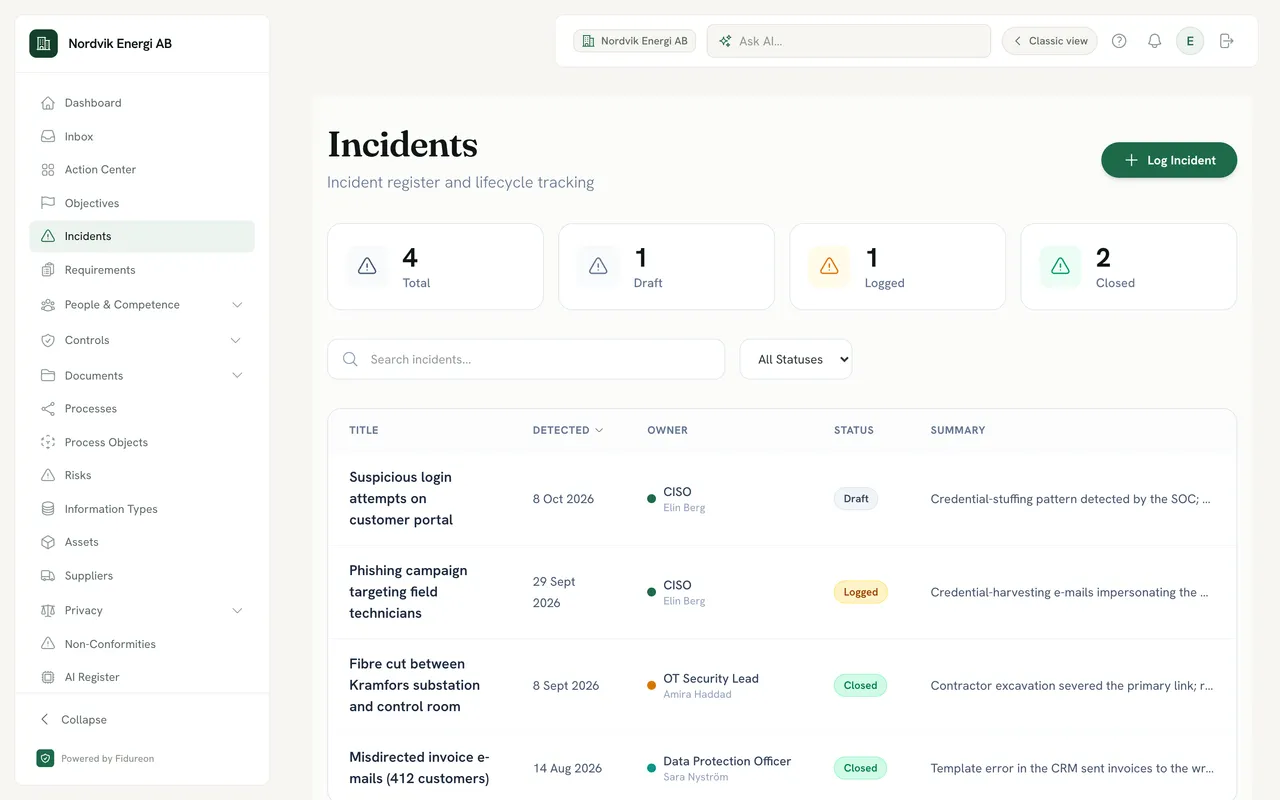
Send a security questionnaire with AI-generated questions. Suppliers answer in a hosted page, no account needed.
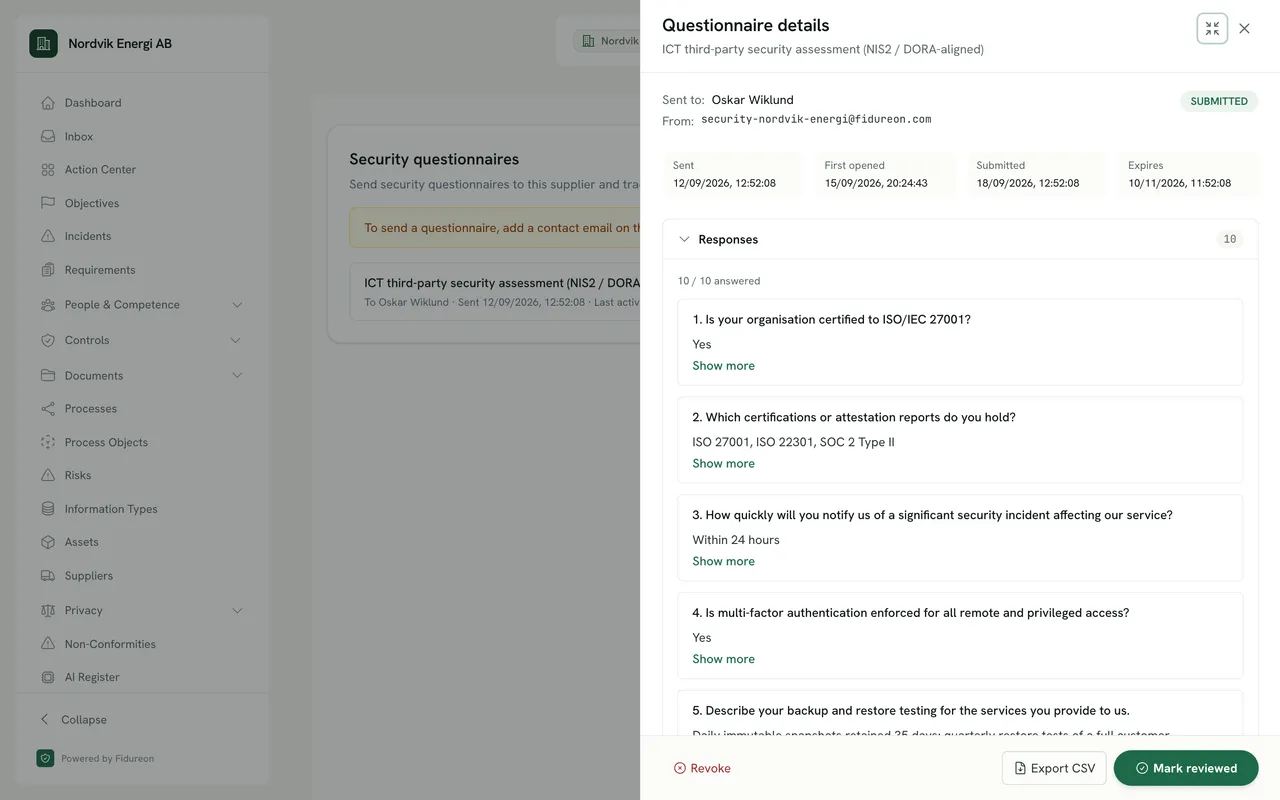
Every answer lands in one place, ready to review and to export as CSV.
DPIA, LIA and TIA
Every assessment starts from the linked process. What is already known is filled in, AI drafts the narrative, your DPO can advise, and the accountable owner records the outcome.
You
Open a DPIA or LIA on a process, or a TIA on a transfer you mapped.
Fidureon
Whatever is already known from the linked process is filled in for you.
AI
Such as a balancing test or a preliminary legal assessment. Marked as AI-drafted, always editable.
DPO
Your DPO can advise before a decision is made. The advice does not decide.
Owner
The accountable owner records the outcome. It is never AI-generated.
DPIAArt. 35
For processing likely to result in a high risk to people.
Covers
Owner decidesResidual risk level and any conditions
LIAArt. 6(1)(f)
When legitimate interests is your legal basis.
Covers
Owner decidesProceed, proceed with safeguards or do not proceed
TIAArt. 44–49
For each transfer of personal data to a third country.
Covers
Owner decidesApprove, approve with measures, suspend or reject
Hosting and AI
Fidureon is built and operated by CShift AB in Göteborg and hosted on Google Cloud in the EU: europe-north1 (Finland) is the primary region, and evidence files are replicated every day to europe-north2 (Stockholm). The AI runs on models hosted in EU data centres: Google’s models on Vertex AI in the EU, and selected flows on Mistral, a European AI company.
Works with your other frameworks
Link a control to each requirement it meets, by hand or with AI suggestions on import, and the same work counts toward GDPR, ISO 27001, the EU AI Act and the other frameworks you run.
For example, one supplier security assessment can count toward GDPR Art. 28 and ISO 27001 A.5.19 once you link it to both.
How one control counts across frameworks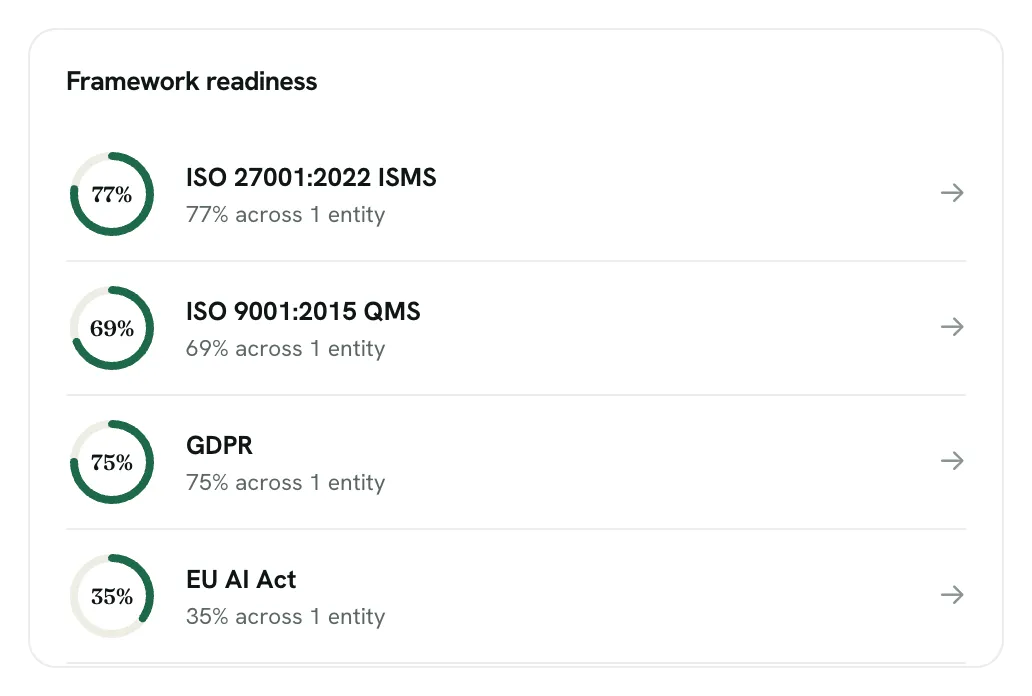
FAQ
No tool can do that on its own, and Fidureon is not a certification. Compliance depends on how you process personal data. Fidureon gives you the 40 requirements from Chapters II to V, the Article 30 register, DPIA, LIA and TIA workflows and the evidence behind each requirement, so you can show your work.
From the processes you draw. On the process canvas, each step links to the assets, information types and suppliers it uses, and you can create a missing record right there with Quick Create. When you save, the links are filled in for you. Mark the process as personal-data processing and it appears in the register with its purpose, data subjects, data categories, recipients, retention, the suppliers that process the data and their DPA status, third-country transfers, security measures and legal bases. This is your record of processing activities (ROPA). Export it as CSV.
It drafts, you decide. Fields that are known from the linked process are auto-filled, and AI can draft the narrative, such as a balancing test or a preliminary legal assessment for a transfer. AI-drafted fields are marked and stay editable. The outcome, such as a transfer decision, is recorded by the accountable owner and is never AI-generated.
Hosted in Google Cloud europe-north1 (Finland), with a daily copy of evidence files in europe-north2 (Stockholm). Database backups stay in Google Cloud’s EU locations. The AI runs on models hosted in EU data centres: Google’s models on Vertex AI in the EU, and selected flows on Mistral, a European AI company.
Not as dedicated workflows. The catalogue includes the data subject rights in Chapter III and the breach requirements in Articles 33 and 34, so you can link the controls, policies and evidence that meet them, and incidents are recorded in the incident log. Requests from data subjects and notifications to the supervisory authority are handled through your own channels.
No. A control can be linked to requirements in several frameworks at once. A supplier security assessment, for example, can count toward GDPR Article 28, ISO 27001 A.5.19 and Cybersäkerhetslagen 2:3.4. You decide the links yourself, with AI suggestions when you import controls from documents or spreadsheets.
More on hosting, sub-processors and AI processing: Security
Book a demo and we will walk through your register, assessments and suppliers using your own processes. Working on ISO 27001 or the EU AI Act as well? Start with the free readiness check.